
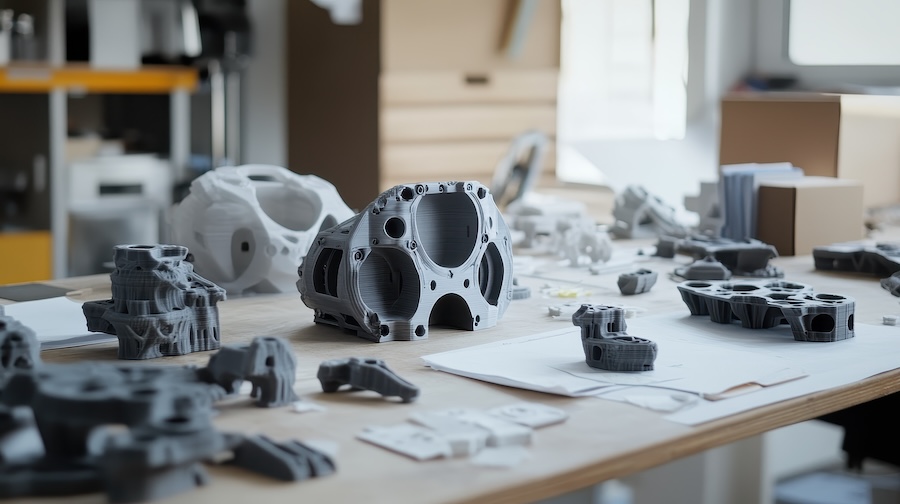


When developing a new product, a functional prototype is often the first real test of whether a design will actually perform as intended. At this stage, choosing the right 3D printing materials becomes critical. The wrong material can produce misleading results, wasted development time, or cause unexpected failures later on.
This article explores how to approach material selection for functional prototyping. It focuses on the practical considerations such as mechanical performance, dimensional accuracy, environmental resistance, iteration speed, and cost, helping engineers choose prototyping materials that reflect real-world use.
What is a Functional Prototype?
A functional prototype is a physical part used to test how a product behaves in real use, not just how it looks. Functional prototypes are intended to validate performance-related aspects such as fit, movement, strength, thermal behaviour, and durability.
In engineering prototyping, functional prototypes are commonly used to:
- Verify mechanical performance under load
- Test assemblies and tolerances
- Assess wear, fatigue, or environmental exposure
- Validate usability before committing to tooling
Because functional prototypes are expected to perform in specific and measurable ways, the material used directly affects how meaningful the resulting validation is and plays a much larger role than it does in early concept models.
Why Material Selection Matters in Functional Prototyping
The 3D printing technique provides access to a wide range of materials, each with distinct mechanical and thermal properties. Choosing a material based purely on availability or unit cost often compromises the value of a functional prototype and causes misleading test results.
Effective prototyping materials should:
- Closely reflect the behaviour of the intended end-use material
- Withstand realistic loads, stresses, or operating temperatures
- Deliver consistent and repeatable results during testing
- Support multiple design iterations without excessive lead time or cost
In practice, material selection in functional prototyping is a careful balance between performance requirements, practical constraints, and the need for rapid iteration.
Key Considerations When Choosing Prototype Materials
When selecting materials for functional prototyping, the following considerations typically matter most.
Mechanical Performance
One of the first considerations when selecting materials for making prototypes is mechanical behaviour. Engineers should evaluate factors such as:
- Tensile and flexural strength
- Impact resistance
- Flexibility and stiffness
- Fatigue performance under repeated loading
For example, nylon-based materials are chosen for functional prototypes that need to be tough and durable, while reinforced polymers may be better suited for load-bearing tests.
Accuracy and Surface Finish
Dimensional accuracy is essential when testing assemblies or moving parts. Some rapid prototyping materials and processes offer tighter tolerances and smoother finishes than others. Inaccurate or inconsistent dimensions can invalidate fit or motion testing, even when the underlying design is correct.
If a functional prototype needs to interface with other components, or if tolerances are critical, material choice should be aligned with a process capable of delivering consistent accuracy.
Thermal and Environmental Resistance
Functional prototyping often involves exposure to heat, chemicals, or outdoor conditions during testing. Materials used for rapid prototyping should be assessed for:
- Heat deflection temperature
- UV stability
- Moisture absorption
- Chemical resistance
Testing a prototype in an unsuitable material may lead to failures that wouldn’t occur in the final part, skewing the results.
Iteration Speed and Availability
One of the main advantages of rapid prototyping is speed. However, some materials are easier to print, post-process, and iterate than others. When multiple revisions are expected, it’s important to consider materials that print reliably, require minimal post-processing, and are readily available. This will ensure the prototyping phase remains agile.
Common Materials Used for Functional Prototyping
While there is no single best material for prototyping, certain materials are more popular than others due to their balance of performance and practicality. Let’s take a look.
Engineering-grade Polymers
3D printing engineering-grade polymers, such as nylon variants, are widely used for functional prototypes where durability, repeatability, and wear resistance are required. These materials are well-suited to mechanical testing and assembly evaluation, and filled or reinforced grades can further improve stiffness and thermal performance.
Tough and High-Temperature Resins
Resins designed for functional prototyping can provide high accuracy and fine detail. Tough or heat-resistant resin materials are often used when precision or thermal performance is more important than long-term durability. As a result, Resin 3D printing is particularly useful for testing fit, snap features, housings, and enclosure geometry.
Flexible Materials
For parts that need to offer some flex, such as the ability to bend, compress, or absorb impact, elastomeric polymers are commonly used. These materials are suitable for gaskets, seals, ergonomic testing, and impact-absorbing features.
Metal Prototypes
In some cases, functional prototyping requires the use of metals to accurately replicate strength, weight, or thermal behaviour. Although metal 3D printing carries a higher cost, it can be essential for critical validation before production. Metal prototypes are typically used later in development, once designs are more stable.
Functional Prototyping and Cost Considerations
Cost is always a factor in prototyping, particularly in early development when designs are still evolving. Material choice directly influences both the cost per part and the total spend across multiple iterations. To manage prototyping costs effectively, it’s worth considering: #
- Material price per part
- Print time and post-processing requirements
- Number of iterations expected
- Risk of inaccurate or misleading results if lower-performing materials are used
In many cases, selecting a slightly higher-performing material earlier reduces overall 3D printing prototype cost by avoiding unnecessary redesigns and rework later.
Final Thoughts
Material selection for functional prototyping is about choosing materials that generate meaningful, reliable insights at the right stage of development.
By clearly defining performance requirements, practical constraints, and testing objectives, engineers can avoid common material selection pitfalls and use prototyping materials more effectively. This helps accelerate development cycles and reduce technical risk before committing to tooling or production.