


When comparing additive manufacturing vs traditional manufacturing, we’re faced with an age-old question: Do we stick with what we know, or take the plunge into what we believe in – even when the outcome isn’t yet certain?
Many high-return investment opportunities face rejection or delay because either:
- The approver doesn’t fully understand the scope of the benefits
- The benefits within one department aren’t sufficient to justify the investment, even though the overall company would benefit.
This article focuses on the former - understanding the full extent of the investment case for additive manufacturing and why I chose to bet big on it personally.
The Problem of Apples for Apples
Whether you’re reading this as an Investor, Production Manager or Design Engineer, you’ll all have wrestled with the “apples for apples” problem in decision analysis.
The broader the brief, the harder the comparison. Inevitably, the once-exciting opportunity falls into the “too difficult” box because you can’t reach a comprehensive and trusted comparison.
DfAM (Designed for Additive Manufacturing)
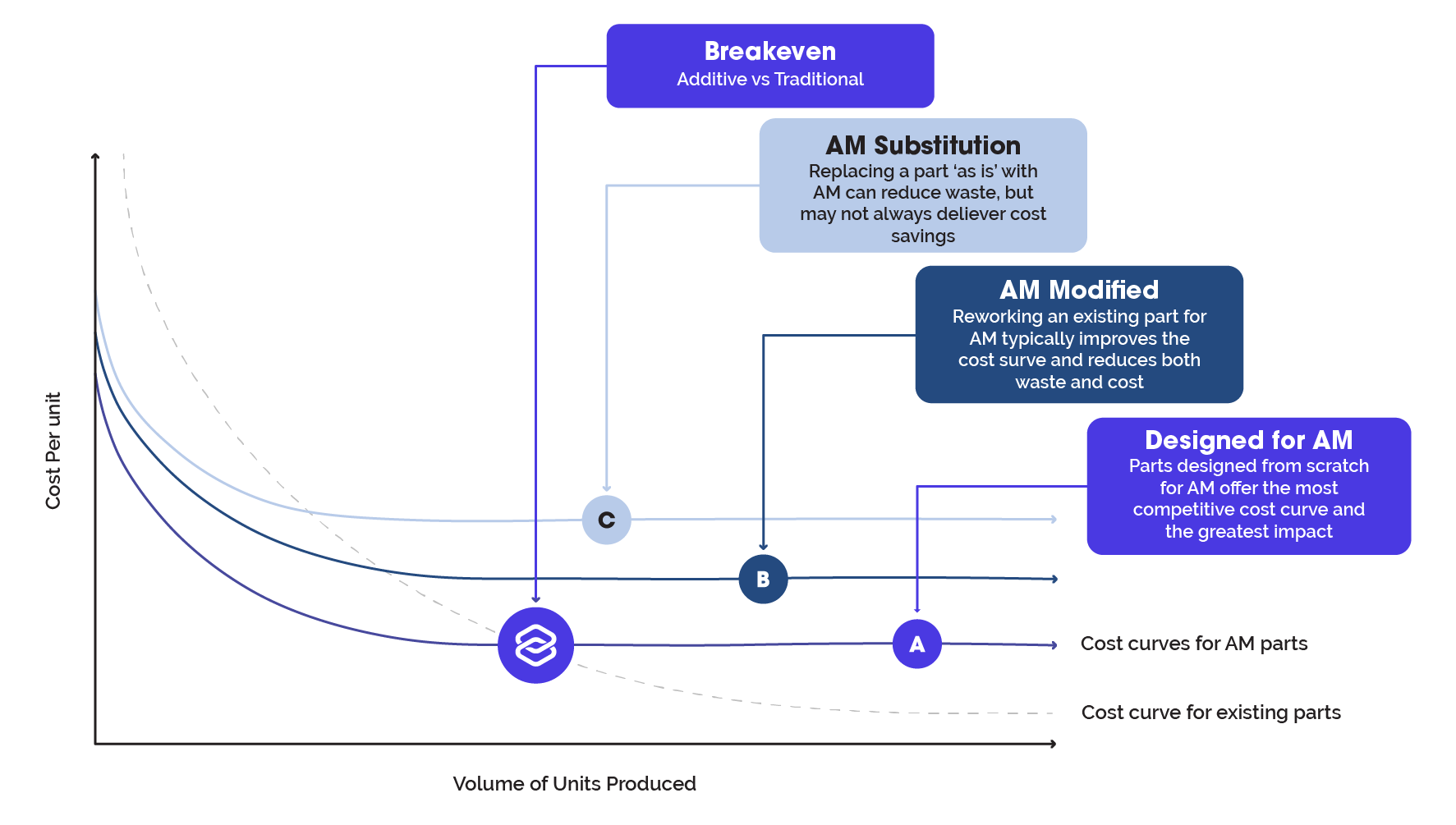
For those new to additive manufacturing, let’s add context to Fig 1.
Remember the iMac G3, released just as the tech bubble burst - with those translucent bright coloured plastics and the 600x800 pixel screens, which is 12% of today’s standard iPad? Now imagine fitting a modern iPad’s hardware inside that old case. Incongruous! Clear folly on so many levels, other than to the most nostalgic among us.
Too often, companies evaluate additive manufacturing against traditional methods by asking: “How much would it cost to produce our existing widget using additive manufacturing?” This is called AM Substitution, represented by point C on the curve.
Traditional production methods, limited by comparison, have shaped how we design for decades. With additive manufacturing smashing such barriers down, we should redesign the whole unit (or iMac G3) and maximise the Designed for Additive Manufacturing capability, represented by point A on the curve.
Between the two lies Modified for AM (MfAM) — a pragmatic middle ground where a component is optimised for AM within a legacy design, reducing material use while maintaining compatibility with existing assemblies. It’s a smart tactical step toward a DfAM strategy, but not a strategy in itself.
Additive Manufacturing Capabilities
The landscape is shifting rapidly. However, it’s not just additive manufacturing’s capability (materials, precision, certification) that has advanced dramatically, but also the productive capacity.
Today, even some high-volume consumer products incorporate additive manufacturing. As I write this, Apple has confirmed utilising 3D printing and advanced additive manufacturing to create a titanium casing for the Apple Watch Ultra 3 — a milestone that would have been unthinkable only a few years ago.
Now, it’s our collective understanding of true “apples for apples” unit costs that limits additive manufacturing adoption far more than technology itself, as businesses work to locate where their components sit on the curve between sheet-metal efficiency and the complexity of my next-generation watch.
Why Additive Manufacturing is Now Competitive
The additive manufacturing landscape has evolved quickly. Material capability, precision, certification, and machine productivity have advanced to the point where even high-volume consumer products now rely on additive manufacturing. Apple’s use of 3D printing for the titanium Apple Watch Ultra 3 is a headline example.
The constraint is no longer technology. It’s how businesses evaluate cost.
The Fixed-Cost Illusion
When evaluating an investment, one of the biggest traps is misunderstanding fixed-cost absorption — how overheads get spread across each unit you produce.
A basic breakdown might look like this:
- £2k for variable production costs (materials + labour)
- £2k for fixed-cost absorption (factory + machinery)
On paper, £2k + £2k = £4k per unit. At first glance, you might assume that an outsourced additive manufacturing supplier simply needs to come in under £4k for the numbers to work. But pause for more than a moment, and a familiar question arises: “What about overheads?”
Overheads, Absorption, and Organisational Complexity
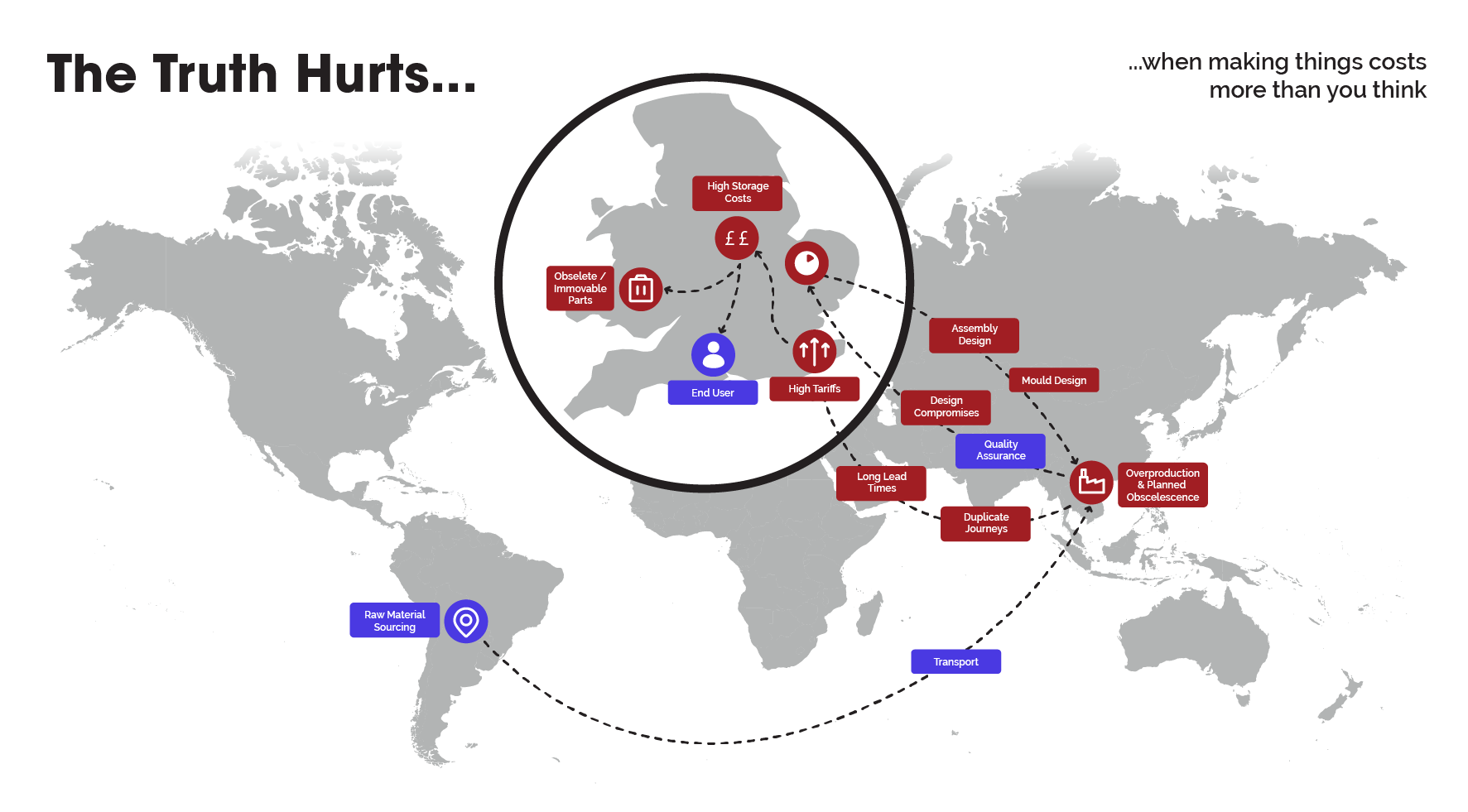
A simple £4k production cost can swell to £10k once overhead absorption and margin requirements are applied. These overheads rarely deliver innovation; they fund supplier management, QA, logistics, inventory financing, and administrative processes — all symptoms of complex global supply chains.
These are essential activities, but they aren’t the ones that move the needle. And when they inflate the “true” cost per unit, they can dramatically distort the comparison between traditional production and additive manufacturing.
Additive Manufacturing’s Rebuttal
Now imagine a model like Truform that removes those burdens. Back to our earlier scenario analysis, our variable costs of production of £2k comprise 50% of total manufacturing costs but only 20% of our £10k RRP.
Imagine your part and production includes the following:
Fewer Parts, Fewer Processes
- A single 3D-printed component replaces multiple assembled parts
- Integrated geometries remove the need for joints, fixings, and additional fasteners
- Designs become lighter, stronger, and cleaner as a result
Less Waste – in Materials and Manufacturing
- Additive manufacturing naturally minimises material waste compared to subtractive or mould-based methods
- Lower waste across design and production reduces both cost and environmental impact
A Simpler, On-Shore Supply Chain
- Only one raw material is needed, delivered directly to an on-shore production centre
- Import paperwork, tariffs, and cross-border transport are eliminated
- A single supplier is responsible for manufacturing, reducing coordination and admin
Digital Inventory, Printed on Demand
- Products or components are stored digitally and 3D printed to order
- Parts can be dispatched directly to the end customer with minimal handling
Improved Financial and Operational Efficiency
- Working capital tied up in stock is significantly reduced
- Risks of theft, stock losses, and handling damage are nearly eliminated
Even with conservative assumptions, investment models show that additive manufacturing often outperforms traditional production once total costs are considered.
Part Consolidation in Additive Manufacturing and Hybrid Strategies
Now consider the impact on either volume or margins as you traverse the demand curve.
Example: Suppose your existing assembly has 20 parts, each stocked, certified, and assembled. By adopting DfAM, you can consolidate to just three parts: two printed and one purchased-off-the-shelf.
- The traditional assembly costs £4k
- The AM-optimised version costs £5k — but overheads drop by £4k
The result: a net gain of £3k per unit through simplicity alone.
In reality, hybrid strategies, combining additive manufacturing with traditional production, often deliver the best short-term economics. Starting that journey now puts you ahead of the curve for when the investment balance tips decisively toward additive manufacturing.
Additive Manufacturing at Scale: The Myth is Broken
But surely additive manufacturing services such as 3D printing are far more expensive than high-volume production? Let’s go back to my Christmas stocking, because The Apple Watch Ultra 3 demonstrates otherwise: when a flagship consumer product reaches cost parity for its metal casing through additive manufacturing, it’s clear the curve has already moved.
So yes, there’s still a cost curve. Yes, additive manufacturing may ask you to rethink your operating model. But no, even AI can’t tell you exactly where your product sits on that curve.
What we can say is that those who start exploring DfAM today will lead the way when the next wave of manufacturing transformation arrives.
Example: Additive Thermal-Management Products
Enough theory. The shift is already visible.
Across the industry, additively manufactured thermal-management products, from advanced heat exchangers to high-performance cold plates, are demonstrating how complex multi-part assemblies can be consolidated into single, optimised structures. Insights from our partners and clients, along with exhibits at Formnext, highlight improvements in performance and manufacturability that, when combined with part consolidation, are creating new opportunities to reduce total cost compared with traditional processes.
It’s not a concept model; it’s production efficiency