


If you’re moving from prototype to production, one of the first decisions you’ll face is how to manufacture your product reliably.
For many early-stage companies, full mass production isn’t viable. Tooling costs are high, minimum order quantities are restrictive, and demand forecasts can be uncertain.
This is where batch production becomes an appealing and relevant option.
In this article, we explain what batch production is, how it works, its advantages, and where additive manufacturing can support early production runs.
What is Batch Production?
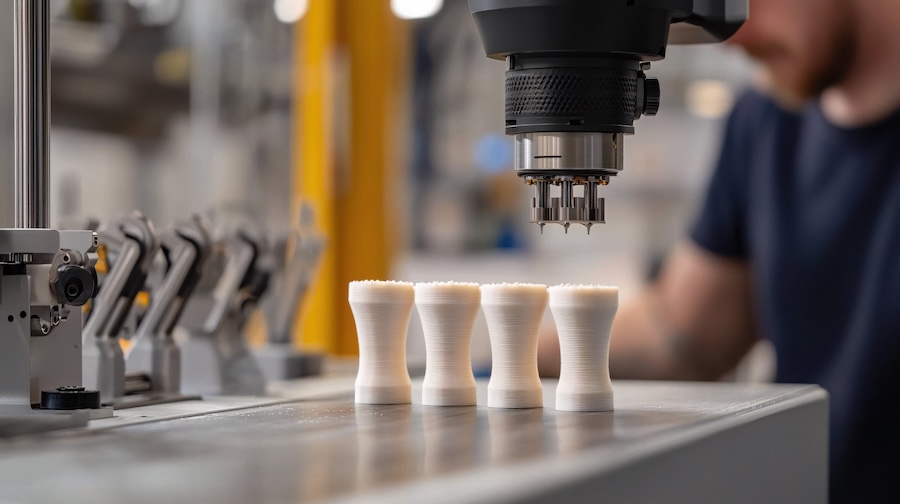
Batch production is a manufacturing method where a set number of identical items are produced together as a group or “batch”. Instead of producing a single unit at a time or running continuous mass production indefinitely, manufacturing is organised into clearly defined runs.
For example:
- Producing 250 units in one run
- Pausing to adjust settings or materials
- Producing the next batch
This structure offers flexibility without losing the efficiency of repeatable production.
The Key Features of Batch Production
Understanding the advantages and features of batch production helps clarify where this manufacturing fits in a product’s development journey. Key characteristics of batch production include:
Defined Production Quantities
Early-stage businesses can’t afford production guesswork. Batch production offers a controlled method of scaling output in line with customer demand. Pre-defined production quantities mean a specific number of units are produced on each run, with the entire batch having to complete one stage of production before moving on to the next. It supports cost control, helps with quality oversight, and keeps production flexible.
Changeovers Between Batches
Equipment is adjusted between runs. This could mean changing materials, design, colours, or configurations. Changeovers between batches allow manufacturers to adapt their output without disrupting the wider production process. This helps maintain precision while allowing output to adapt between runs.
Moderate Automation
Batch manufacturing often incorporates automated processes, but typically not at the scale of fully continuous production lines. Machines may run with pre-programmed instructions and repeatable toolpaths, but human oversight remains integral. This balance enables manufacturers to benefit from efficiency and repeatability while retaining the ability to intervene and optimise between batches.
Flexibility
Production can be adjusted between batches based on market feedback, testing results, or demand. This means design improvements can be implemented without waiting for long production cycles to finish, materials can be substituted if performance requirements change, and quantities can be increased or reduced based on real-world sales data. This iterative approach reduces commercial risk, limits overproduction, and keeps output aligned with real demand.
Batch Manufacturing vs Mass Production
To put batch production in context, it helps to compare it with other manufacturing models. Each approach serves a different commercial purpose, depending on volume, predictability, and required flexibility.
Mass Production
Mass production is designed for very high volumes and consistent demand. It typically relies on dedicated tooling and fixed production lines that run for extended periods with minimal variation.
The main advantage is a low unit cost once production is fully scaled. However, this efficiency comes with high upfront investment and limited flexibility. Design changes can be expensive, and production adjustments are difficult once tooling is in place.
Mass production works best when demand is stable, forecastable, and unlikely to fluctuate significantly.
Continuous Production
Continuous production operates with constant output and minimal interruption. It is most commonly used in process-driven industries such as chemicals, food, and large-scale material production.
This method is extremely efficient at very high volumes, but requires significant infrastructure and standardisation. It’s rarely a good fit for early-stage product businesses that are still refining designs or demand.
Batch Manufacturing
Batch manufacturing sits between one-off production and full mass production. It supports moderate volumes and organises output into defined runs rather than indefinite cycles.
Because equipment can be adjusted between batches, this model allows for iteration, material changes, and incremental scaling. It also involves a lower initial financial commitment compared to fully tooled mass production.
For startups and growing product businesses, batch manufacturing often provides the practical bridge between prototype development and large-scale manufacturing. Learn how additive prototyping accelerates early-stage production.
Batch Production and Additive Manufacturing for Growing Products
For growing product businesses, batch production rarely exists in isolation. It often intersects with modern manufacturing technologies such as additive manufacturing.
Startups and growing product businesses often face:
- Uncertain or fluctuating demand
- Ongoing design revisions
- Limited budgets for tooling and upfront investment
- Little in-house manufacturing experience
Batch manufacturing provides a more controlled pathway. It allows companies to validate demand, refine product design, and manage cash flow without locking into long-term production commitments. For more on this, check out our article When Additive Manufacturing Makes Commercial Sense than traditional manufacturing.
In this context, additive manufacturing can support batch production, particularly when:
Volumes Remain Relatively Low
If you need 100, 300, or 1,000 units, investing in mould tools may not yet be commercially viable. Additive manufacturing enables production without hard tooling, reducing upfront capital requirements.
The Design is Still Evolving
Traditional manufacturing may require tool modifications between batches. With additive processes, updates can often be made at the file level before the next production run.
Complex Geometry Delivers Performance Benefits
Additive manufacturing supports part consolidation, lightweighting, and intricate internal structures that would be costly or impractical with conventional methods.
Market Validation is Still Underway
Early production runs can fulfil crowdfunding campaigns, beta programmes, or limited launches while testing real-world demand before scaling further.
In these scenarios, additive manufacturing does not sit outside batch production. It becomes a flexible and commercially sensible way to deliver it, particularly when provided through Truform’s on-demand 3D printing services, which support both early prototypes and low-to-moderate production runs without tooling investment.
Final Thoughts
Batch production is less about scale and more about control. It gives businesses a structured way to move forward without overcommitting too early, allowing manufacturing decisions to evolve alongside the product itself.
For growing companies, the real advantage is optionality: moving forward while protecting cash flow and flexibility. Rather than locking into a single path, batch production keeps routes open, whether that means continuing with additive methods, transitioning to bridge manufacturing, or scaling into mass production when the time is right.
The most effective manufacturing strategy is rarely the fastest route to volume. It is the one that matches your stage of growth, preserves agility, and supports long-term commercial viability.