-1.JPG)
How 3D Printing Complements, Rather than Competes with, Public Art
Public art carries meaning not only through form and material, but through context, access, and shared experience. As artists and commissioners look for ways to broaden engagement without compromising craft, 3D printing can play a supporting role.
This case study explores how 3D printing was used to extend the reach of a culturally significant public sculpture, complementing traditional creative practices.

Enhancing Artistic Expression with 3D Printing
Truform were honoured to support London-based artist Rayvenn Shaleigha D’Clark on Mother Vérité, a hand-crafted bronze sculpture recognised as London’s first public artwork to depict the postpartum experience.
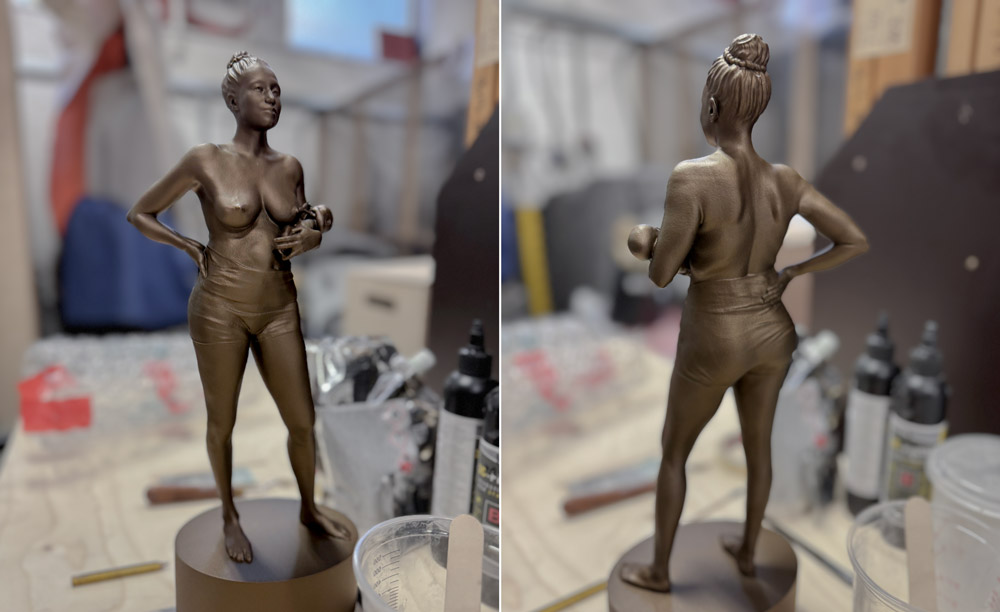
Truform’s role was to create a small number of high-quality 3D-printed miniatures that replicated the original sculpture, allowing the work to extend beyond its physical installation. The intention was to support wider engagement, accessibility, and storytelling.
The project demonstrates how 3D printing can enhance artistic expression without replacing the traditional craft.

Introducing Rayvenn Shaleigha D’Clark
Rayvenn is a London-based artist working mainly in sculpture and public art. Her work focuses strongly on narrative, representation, and how people engage with storytelling in the public realm. Craft, materiality, and process are central to her practice, particularly where the subject matter carries cultural or emotional significance.
In October 2025 Rayvenn unveiled Mother Vérité, a seven-foot bronze sculpture depicting a woman cradling her newborn child and exposing the often hidden realities of the postpartum experience.
In a city where only 4% of public statues depict named women, and none show what the body looks like after birth, Mother Vérité stands as a powerful symbol of womanhood, publicly celebrating the strength and resilience of mothers – making the invisible visible.
Navigating Replication in a Public Art Context
When Truform were approached to support Rayvenn on this project, it was immediately apparent that the work demanded more than technical accuracy alone. Any replication of the sculpture would need to respect the emotional significance, artistic intent, and cultural importance of the original. We had to support Rayvenn’s vision without competing with or diminishing it.
From a practical perspective, the challenge lay in producing physical miniatures that retained the presence, detail, and integrity of the original work, while being clearly understood as secondary pieces rather than replacements. The miniatures needed to feel considered and intentional, not reduced or overly mechanical.
Balancing accessibility with responsibility was therefore central to the challenge. The miniatures were intended to help the work reach a wider audience, but doing so required careful decisions around scale, finish, and process to ensure the emotional weight, craft, and meaning of the original sculpture remained intact.
Extending the Work’s Reach, Not Replacing It
Truform was engaged to produce a series of high-quality physical miniatures of Mother Vérité, focused on accurate translation into physical form. The aim was not to replicate the sculpture for scale or efficiency, but to create objects that could act as extensions of the work, supporting storytelling, engagement, and accessibility beyond the fixed installation.
Interpreting the Sculpture for Replication
The starting point was careful consideration of how replication should function within a public art context. Rather than treating the miniatures as reduced engineering models, the focus was on preserving proportion, posture, and surface character in a way that felt respectful to the hand-crafted bronze original. This required close attention to scale, detail resolution, and how the sculpture would be experienced tactually and visually at a smaller size.
Balancing Fidelity, Finish, and Restraint
Decisions around print quality and finishing were guided by the need to balance accuracy with restraint. The miniatures needed to communicate the same narrative and physical presence as the original work, without appearing overly processed or mass-produced.
Truform advised on appropriate levels of surface refinement to ensure the printed miniatures faithfully captured the sculpture’s subtle details, from stretch marks and tired eyes to messy bun, in a way that felt honest and true to the original work.
The finished replicas were produced in PA12 using HP Multi Jet Fusion (MJF), followed by vapour smoothing and a Cerakote finish to achieve the final look and feel.
Care Beyond Production
Throughout the project, Truform’s role extended beyond production alone. While the sculptural form was already well resolved, professional judgement was required to ensure manufacturing decisions aligned with the artistic intent and cultural sensitivity of the work.
By approaching this project with care, restraint, and an understanding of the cultural context, Truform demonstrated how additive manufacturing can sit alongside traditional sculptural practice, enhancing reach and interaction while preserving the integrity of the original piece.

Truform produced gorgeous, beautifully crafted miniatures that captured the essence of my sculpture with real precision and care.
Connecting People with Tangible Art Experiences
The result was a small number of miniatures that felt deliberate and considered, rather than mass-produced. They were shared with key people at launch events, helping communicate the story and intent of the artwork beyond the physical installation.
The response Rayvenn has received highlights a clear appetite for extending the reach and accessibility of Mother Vérité through further miniatures. Importantly, the approach we developed with Rayvenn is repeatable, allowing additional pieces to be produced consistently as demand grows, without compromising the integrity of the original work.
Complementing Artistic Practice with 3D Printing
This project reinforced that, when handled with care, replication becomes a means of extending art access and engagement, rather than diluting the significance of the original work. The value of the hand-crafted sculpture remains anchored in its material presence, scale, and context, while the miniatures act as supporting artefacts that help carry its story further.
The collaboration also highlighted how 3D printing is still frequently misunderstood outside engineering-led industries. When approached with the same sensitivity and judgement applied in traditional craft, 3D printing can be a precise and expressive tool.
Crucially, Truform’s contribution extended beyond technical execution. The success of the project depended on professional judgement, restraint, and an understanding of cultural context. Small, purpose-led production runs proved particularly well suited to an art project where quality and sensitivity matter more than scale or efficiency.
Final Thoughts
This project illustrates how additive manufacturing can be used thoughtfully within creative and cultural context as a means of extending reach, access, and dialogue.
For artists, designers, and commissioners exploring how physical work might travel beyond a single installation, small-scale 3D printing offers a considered, repeatable way to support engagement while preserving the integrity of the original piece.
Let's Talk
If you are working on a project where quality, sensitivity, and intent matter as much as technical execution, Truform is always open to thoughtful collaboration and conversation.