Precision CNC Machining Services
Custom parts in metal and plastic, prototype to production
CNC machining makes parts that match their drawing, and match each other across the whole run. The machine cuts each one the same way, so the last comes out just like the first. Where machining is the right fit, Truform carries the job through from drawing to finished part.

What is CNC Machining?
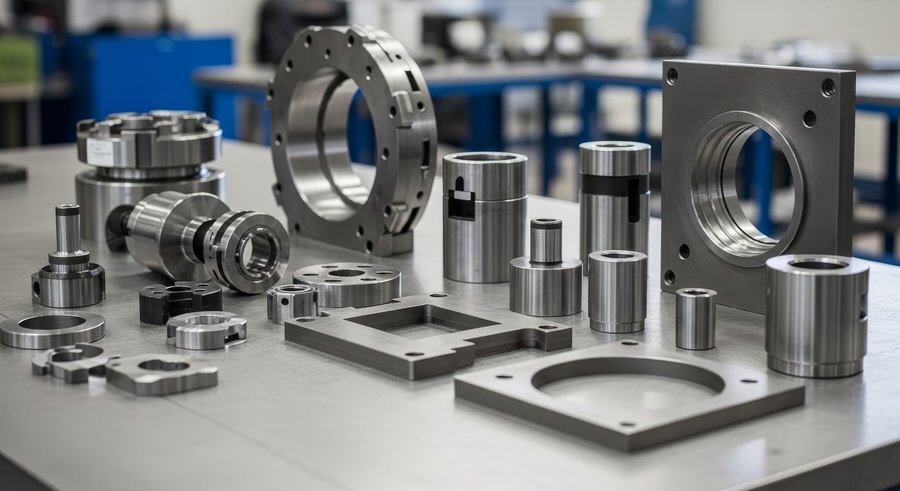
CNC machining cuts a finished part from solid stock, under computer control, taking material away until only the part is left. It mills flat faces and pockets, shapes round parts as they turn, and finishes the surface in a final pass. Because the cutting path comes straight from the CAD model, every part in a batch is cut to the same dimensions.
How Parts Are Machined
Machining starts with the part’s geometry, usually a drawing or CAD model with the tolerances and material called out. Where the part exists only as a physical sample, Truform captures it first by 3D scanning and reverse engineering, then machines to the recovered geometry.
How a part is machined depends on the part. Geometry decides whether it is milled, turned, or both, and how many setups it takes to reach every face. Tolerance sets how tightly each feature is held, material governs which cutting tools and speeds to use, and the finish on the drawing determines how the surface is left after the last cut.
Most parts are made with a small set of operations, used alone or combined as the part calls for:
Milling
Cutting faces, pockets, and slots from a fixed block while the tool moves around the part.
Turning
Shaping cylindrical parts, shafts, and bushings on a lathe, holding every feature to the same axis.
Multi-Axis Machining
Cutting several faces and angles in fewer setups, so related features stay aligned without moving the part between them.
Parts We Machine
Truform machines a range of custom parts, each with its own demand on accuracy and finish. A machined part is measured from a datum, a single face chosen as the reference. If the wrong face is selected, a feature can be within its own tolerance but still out of position against the rest, so the part will not assemble. Pick the faces the part is located by, and its features line up, so it goes together first time.
Precision Components
Close-tolerance machined components where fit and function depend on holding dimensions across the whole batch.
Production and Batch Parts
Repeat and low-volume parts machined to a locked setup, so each one holds the same tolerance.
Functional Prototypes and One-Offs
Single parts machined in the production material, so an early part behaves like the final one.
Housings, Brackets, and Fittings
Structural and enclosure parts machined from solid metal where a moulded or printed part would not hold up.
Who We Work With
Engineers and manufacturers across several sectors come to Truform, working to different tolerances and volumes:

Industrial Components
Close-tolerance parts for valves, housings, and assemblies across industrial components.

Automotive and Aftermarket
Production, motorsport, and automotive aftermarket parts machined to spec and held across a run.

Manufacturing and Fabrication
Machined components that keep fabricated and machined work consistent at volume.

Product Design and Development
Machined parts and prototypes that move with a design toward production.
Why Choose Truform for CNC Machining?
Every Truform CNC part is made and checked as one job, cut to the drawing and then measured against it before it ships.
What Truform brings together in its CNC machining services:

A machined part is rarely needed only once. Parts wear, designs move on, and a line that runs one batch will often need the next. Truform keeps the geometry and the program behind each part, so the same part can be run again whenever it is needed.
FAQs
What tolerances can CNC machining hold?
It depends on the feature, material, and part size. Critical dimensions are held tighter than general ones, and any tolerance tight enough to drive cost or lead time is flagged at quotation.
What materials can be CNC machined?
Most engineering metals and plastics, from aluminium and steel to brass, acetal, and nylon. The choice follows what the part must withstand in service.
What lead times apply to a CNC machining order?
Lead time follows the geometry, material, finish, and quantity. A simple part in a stocked material moves quickly, but a hard material or fine finish adds time. This is flagged where a deadline is tight.
What drives the cost of a machined part?
Mostly machine time and material removed, then setups, tolerance, finish, and quantity. Cost follows the engineering rather than setting it, so the part is specified for its job first and priced from there.
Machine Your Next Part with Truform
One component or a full batch, send us a drawing or the part itself, and tell us the tolerance and finish it must hold. Truform will recommend how to machine it, cut it to the drawing, and keep the program so reordering is a rerun, not a restart.