

A deep bore is one of the harder things to get right in a machined part, because it has to stay straight and on size the whole way down. Whether it runs right through the part or stops as a blind hole, a deep bore that drifts off axis can leave uneven wall thickness or run into a feature it was meant to clear, and that usually surfaces once most of the machining is already done. Getting it right starts well before the first cut, with the choice of which deep hole drilling process the bore needs. Gun drilling, BTA, and deep hole boring each suit different work, and a few engineering factors decide between them.
What Is Deep Hole Drilling?
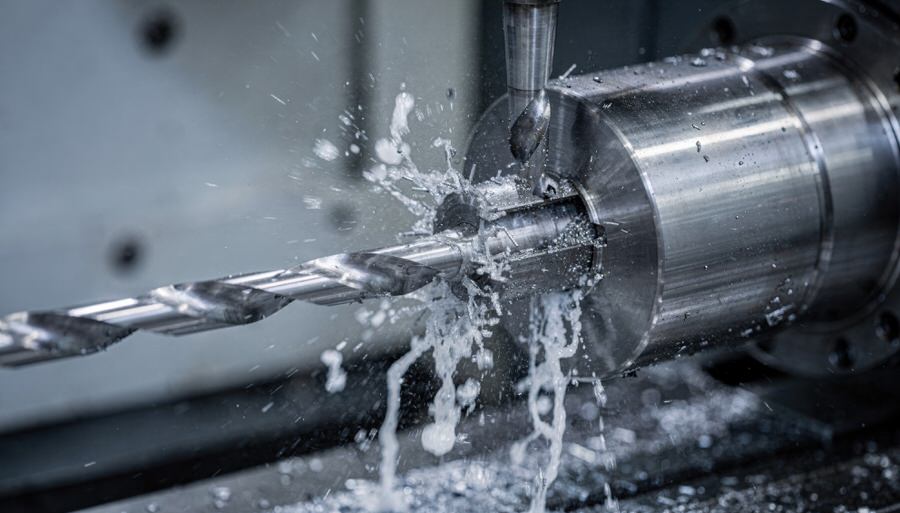
Deep hole drilling is a set of machining processes for producing holes far deeper than an ordinary drill can reach, where the depth is many times the diameter. A hole is usually counted as deep once its depth-to-diameter ratio passes about ten to one. A common twist drill is comfortable to around five times the diameter, and a high-performance drill with coolant fed through the tool can reach about ten. Past that, the job an ordinary drill does gets harder. Coolant has to travel the length of a long, narrow bore to reach the tip, and chips have to come all the way back out without packing or scoring the wall. Deep hole drilling processes handle that by delivering coolant under high pressure and giving the chips a dedicated path out, which is what keeps a hole on line.
What Drives the Right Process
The deep hole drilling process a bore needs comes down to a handful of factors, usually weighed against each other:
- Diameter does more than anything to point toward one process over another, and it's read alongside the depth-to-diameter ratio, which sets how hard the hole is to keep straight and clear.
- Material is the next thing to weigh. A free-machining steel behaves nothing like Inconel or duplex stainless, and the tougher the alloy, the more the cutting parameters and chip control have to work around it, which is why the grade belongs on the drawing from the start.
- The finished quality of the bore shapes the rest of the decision. Straightness and allowable hole deviation often decide whether drilling alone is enough or whether additional machining is needed to achieve the required bore geometry. A surface that has to seal or carry a sliding fit needs a finishing pass the drill can’t give it.
These factors work together rather than one at a time. For example:
- A modest diameter at a shallow ratio in mild steel is a single-operation job.
- The same diameter at a high depth-to-diameter ratio in a nickel superalloy, with tight straightness and surface-finish requirements, may need several machining operations.
- Weighing all of them before any metal is cut is what keeps the right process from being chosen too late.
The Three Types of Deep Hole Drilling
There are three main types of deep hole drilling. Two of them do the drilling and the third opens and finishes the bore afterward, and these deep hole drilling techniques are separated by how coolant reaches the tip and how the chips get back out. Which type of drill is used comes down to the diameter, depth, and material of the bore.
Gun Drilling
Gun drilling uses a tool with a single cutting edge. High-pressure coolant runs through the centre of the tool, and the chips flush back out along a groove on the outside. It holds a straight, accurate bore at smaller diameters, from around one millimetre up to about twenty-five. Gun drilling and BTA are the two most often weighed against each other, and the choice between them is driven largely by bore diameter, depth and material.
In short: Gun drilling is the first choice for long, narrow bores like a fuel passage or a small hydraulic line.
BTA Drilling
BTA drilling reverses the coolant path. The coolant is fed around the outside of the tool, and the chips travel back out through the centre of the drill tube. This can cut faster than gun drilling at the same diameter and handles larger bores and tougher alloys. Its range runs from around twenty millimetres up to roughly two hundred.
In short: Where a bore is suitable for either process, BTA can offer a faster route.
Deep Hole Boring
Boring is the step that can follow drilling. It enlarges an existing bore to achieve the required diameter and geometry. It also covers bores too large or too demanding to produce in a single drilling pass. Honing comes last where required, refining the bore’s diameter, geometry, and surface finish for the close-fitting and sliding surfaces that depend on it.
In short: Boring and honing can be used where additional dimensional accuracy, bore geometry or surface finish is required.
Matching the Process to the Component
Different parts lead with different factors.
Hollow drive and pump shafts
Bored to carry coolant or shed weight. Staying straight is the whole job.
Hydraulic cylinder barrels and manifolds
Long bores paired with intersecting passages. They need a fine finish for their seals.
Mould-tool cooling channels
Run straight through tool-steel blocks to pull heat from the cavity.
Oil and gas housings
Bored in specialist alloys. The alloy drives how the bore is cut.
Aerospace actuator cylinders
Bored to close straightness in high-strength alloys, which also carry supplier requirements reaching well past the drilling itself.
In most cases the drilling is one specialist step inside a longer process. The bore is planned against the drawing, the features around it (outside diameters, faces, cross-holes and threads) are turned and milled, with boring and honing added where required to achieve the specified bore geometry and finish. Where there’s only a part and no drawing, the dimensions can be recovered by reverse engineering. When the bore is planned into the sequence, the steps before it leave the right amount of material to work with, and the steps after can bring it to final size.
Truform handles the deep hole drilling through a specialist accredited to AS9100 and ISO 9001 and manages the full job from drawing to delivered bore.